
How to choose lamps and fixtures for outdoors?
Outdoor lighting has similarities and differences compared to indoor lighting. Solutions are available in all shapes and sizes. This article provides an overview of recent developments and evolutions in outdoor lighting. Practical tips and advice adressed to installers are also covered.
Importance of outdoor lighting
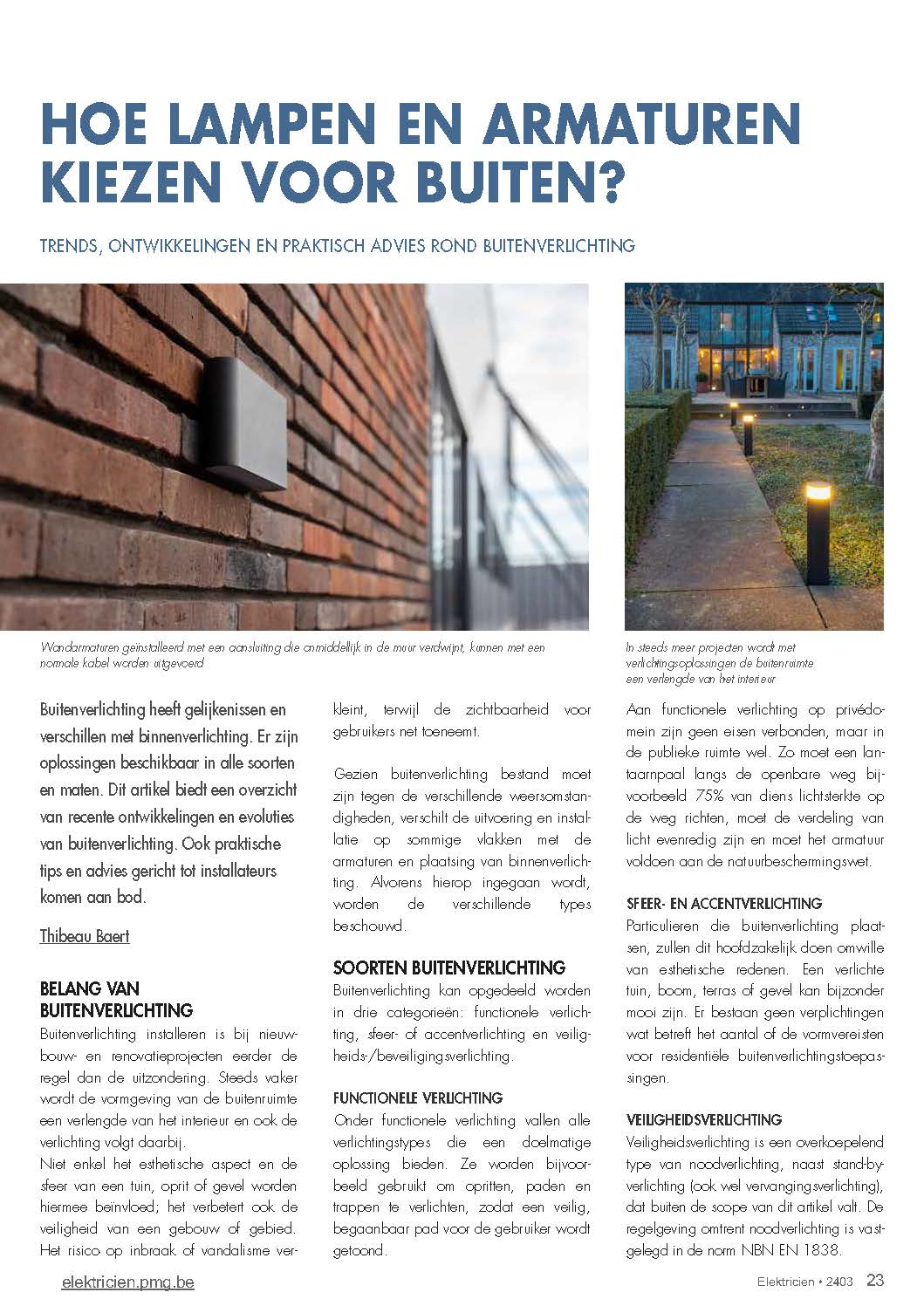
Installing exterior lighting is usually the standard in new construction and renovation projects. More and more often, the design of an outdoor space becomes an extension of the interior and the same goes for lighting.
Lighting does not only influence the aesthetic aspect and atmosphere of a garden, driveway or facade; it also improves the security of a building or area. The risk of break-ins or vandalism reduces, while visibility for users just improves.
Since outdoor lighting must be weather resistant, its able to resist different weather conditions, the design and installation differs from indoor lighting. But first, let’s have a look at the different outdoor lighting types.
Types of outdoor lighting
Outdoor lighting can be divided into three categories: functional lighting, ambient or accent lighting and safety/security lighting.
Functional lighting
Functional lighting includes all lighting types that provide a purposeful solution. For example, they are used to illuminate driveways, paths and stairs to show a safe, walkable path for the user.
There are no requirements for functional lighting on private properties, but there are requirements in public spaces. For example, a lamppost along a public road must direct 75% of its intensity at the road, the distribution of light must be equal and the luminaire must comply with the Nature Conservancy Act.
Mood and accent lighting
Individuals who install outdoor lighting will do it primarily for aesthetic reasons. An illuminated garden, tree, patio or façade can be particularly beautiful. There are no obligations regarding the number or shape requirements for residential outdoor lighting applications.
Safety lighting
Safety lighting is an umbrella type of emergency lighting, in addition to standby lighting (also known as replacement lighting), that is beyond the focus of this article. Regulations on emergency lighting are laid down in the standard NBN EN 1838. Safety lighting is the light that must be switched on when the usual lighting stops working because there is no power anymore.
In order for people to evacuate safely and peacefully, escape route lighting is required in public and many non-residential buildings.
An adequate level of lighting is not only necessary on the inside, but also on the outside of the final evacuation exit. The escape route lighting should be provided up to the gathering point and continuing outside the building.
How to choose lamps and fixtures?
As with indoor applications, the outdoors are also making a massive move toward LED fixtures. LED's are more energy-efficient than conventional bulbs, have a long lifespan and can be dimmed.
In addition to the type of lamp, there are some requirements and concerns related to the lighting features and regarding the fixtures and lamps on their own.
Light features
The Color Rendering Index or CRI value represents the level of true-to-nature reproduction of the light color. For outdoor applications, this parameter is less important than for indoor applications. A minimum value of 70 is usually required.
Warmer or cooler looking lighting is calculated by the value of light color and expressed in Kelvin. Warm white corresponds to 2700 to 3000K and suits decorative applications. A neutral white color is around 4000 to 5000K, ideal for area lighting.
Some manufacturers offer LED fixtures on the market that contain a CCT switch (DIP switch type). This allows the user to pre-set the lighting according to different light colors, often with three choices.
The light beam defines how the lightspread occurs and can be either symmetrical or asymmetrical. Matching the light spread correctly to the area can prevent light disruption in the surrounding area. A polar diagram, also called a light spread, light intensity or light intensity curve, is used to read the light intensity emitted by the light source in different directions.
The power (wattage) consumed by a lamp is related to the amount of light emitted. The light quantity is expressed in lumens. As lamps become increasingly energy-efficient, the number of watts needed per lumen is less and less. Some fixtures are equipped with a power switch. This allows the power, and therefore the amount of light, to be set on the fixture by using these power switch.
Fixture and lamp requirements
The most obvious requirement for outdoor lighting is water resistance. The IP rating indicates how water- or dustproof a particular object is. The IP rating consists of 2 digits, the second number indicating how waterproof the fixture is.
For outdoor applications, IP44 is a minimum requirement, indicating a fixture that is splash-proof. For decorative outdoor wall fixtures, this is just about enough. More common and even crusial in, for example, commercial constructions are fixtures with IP65. These are resistant to water splashes. A splash water resistant type of IP55 or IP65 is also usually chosen for outdoor switches.
Finally, lighting can also be recessed into a floor surface; e.g a driveway or patio. For these situations, IP67 or even IP68 is the best choice. This rating provides protection against flooding.
Outdoor lighting also needs to resist mechanical impact. Not only in environments where there is potential danger of vandalism, but also to resist a hailstorm, for example. The resistance of a fixture to impact damage is classified according to IK values, ranging from IK00 (no protection/resistance to impact) to IK10 (the highest class).
Through simulations of a mechanical impact on a type of lamp, a manufacturer can guarantee IK certification on its products. In public places, luminaires with class IK08 or higher are recommended.
Each device has a certain temperature range within which it can operate. This is often between -20°C to +50°C, but varies from manufacturer to manufacturer and lamp type. Some fixtures have a safety mechanism built into them that shuts off the device in extreme temperatures to prevent damage.
As with all building materials used in outdoor environments, UV and corrosion resistance of the housing is also a requirement for lighting fixtures. When using luminaires in salty environments, such as at the coast, it is advisable to choose lighting fixtures that have also been tested for salt resistance.
Electrical connection installation
When installing outdoor lighting, as with all electrical components and connections, all regulations contained in the AREI must be respected. Manufacturers' recommendations, for example on technical data sheets, are subject to the requirements imposed by the AREI.
In this way, not only is operational safety guaranteed, but the installation is also safe and correctly implemented in terms of grounding and overvoltage protection.
Wiring
Electrical cables in an outdoor environment must be UV-resistant in addition to being waterproof, depending on the application. Wall luminaires connected with a cable running directly into the wall can connected with a normal cable.
Ground spots in the surface of a patio or driveway require a connecting cable that remains flexible at lower temperatures and is also resistant to chemicals. A cable with a PU jacket is often used.
Maintenance
Like any building component, lighting is subject to wear and tear. Checking and cleaning fixtures regularly and replacing bulbs that are broken is a job that every good family man should take on. The cable work also deserves attention: damage, also by (gnawing) animals, can create dangerous situations. A maintenance contract is an option for outsourcing this work.
Finally, to meet the lighting needs at buildings and public places, ‘LaaS’ is also an option. Light as a Service is a more recent development in terms of outsourcing the installation, maintenance, repair and management of the entire lighting installation to an external party. Fixtures and lamps are in this way being leased instead of purchased.
Trends in outdoor lighting
Some trends that are now almost completely integrated are, for example, the bigger use of LED lighting, linking lamps to dimmers, timers and/or motion detectors, and the increasing use of smart solutions that can be operated with an app or integrated into a home automation system.
Then there is also the integration of fixtures with other technical solutions and systems, for example a DALI control system. Light sources that are directly connected to a light sensor can automatically adjust the luminous flux to the light requirement.
Another recent development is the direct connection of light sources to alarm systems or fixtures, in these cases a sensor is embedded to detect motion (microwave sensor) or temperature differences (PIR sensor).
 Overview

